2025 Annual Report
Damir Akhoundov
ERAI, Inc.
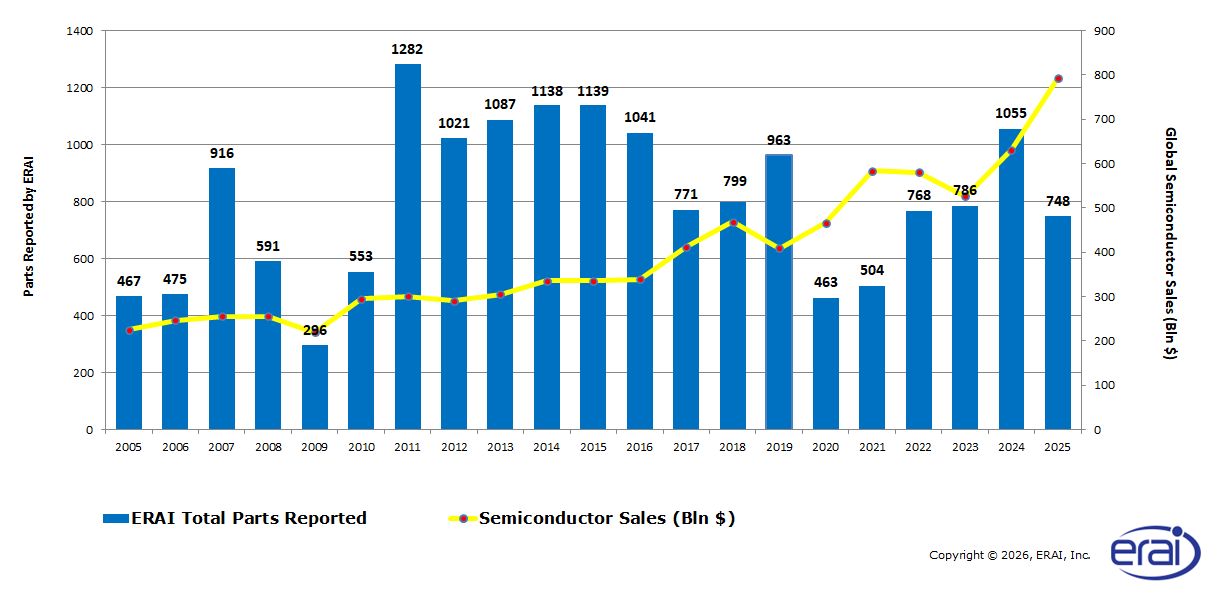
The 2025 ERAI Annual Report indicates a decline in the total number of parts reported to ERAI compared to 2024, marking a notable departure from previously observed trends. Historically, fluctuations in reported parts have closely mirrored global semiconductor sales; however, in 2025, reported parts decreased by 29.1% despite a 25.57% increase in global semiconductor sales. This divergence highlights a shift in market dynamics. Additionally, findings from 2025 reveal that counterfeiters continue to target parts that are readily available through authorized distribution channels, while also broadening their scope to include components from an increasingly diverse range of manufacturers.
Total Number of Parts Reported to ERAI
In 2025, ERAI reported a total of 748 parts, representing a 29.1% decrease from the previous year and aligning more closely with levels observed in 2022 and 2023.
This decrease can be partially attributed to a batch of 248 parts reported by the U.S. Government in May 2024. When excluding this batch, the decrease from 2024 to 2025 is only 7.4%, suggesting that 2025 continues the previous years’ trend observed prior to the 2024 spike.
Despite a significant increase in global semiconductor sales (25.57% growth from 2024 to 2025, according to the Semiconductor Industry Association), no corresponding increase in reported parts was observed. One possible explanation is that approximately 35% of industry growth in 2025 was driven by demand for high-end AI-related components, which are more difficult to counterfeit due to their complexity and regulatory controls.
Reported Parts vs. Global Semiconductor Sales 2005 - 2025
Types of parts reported to ERAI in 2025
We analyzed the types of parts reported to ERAI in 2025 and compared them with data from the previous 5 and 10 years. While “Other” was the most reported category in 2024—due to the batch of counterfeit fan assemblies reported by the U.S. Government—2025 returned to the typical distribution.
Programmable Logic ICs, Analog ICs, Microprocessor ICs, and Memory ICs once again comprised the largest segment of suspect counterfeit and nonconforming parts reported to ERAI.
Part Types Reported in 2025 vs. Last 5 and 10 Year Periods
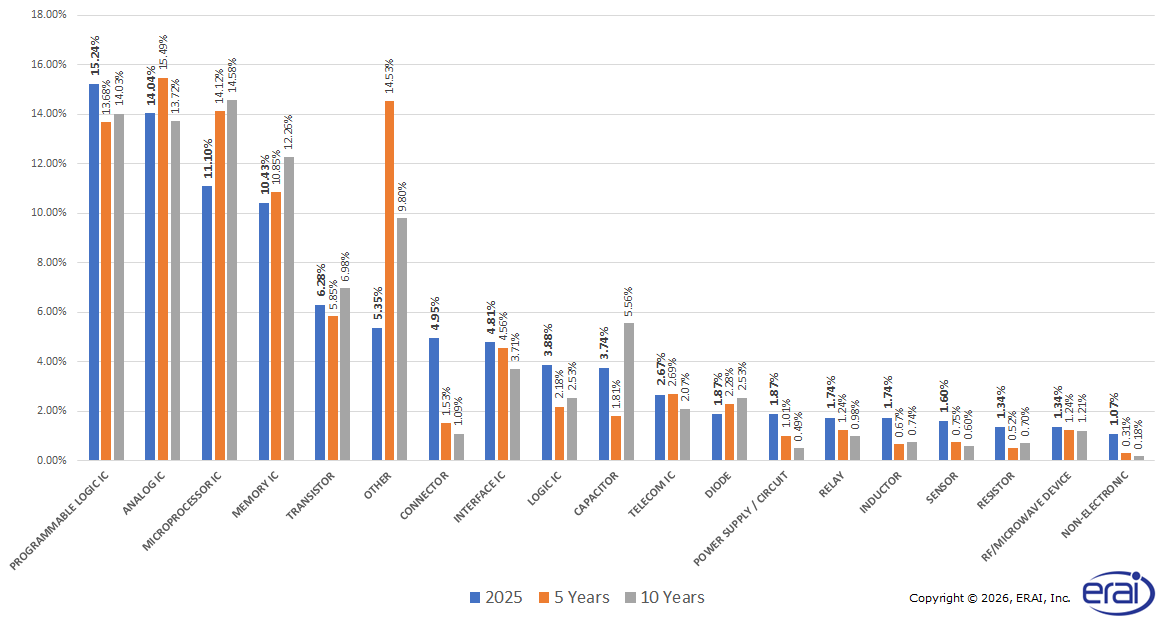
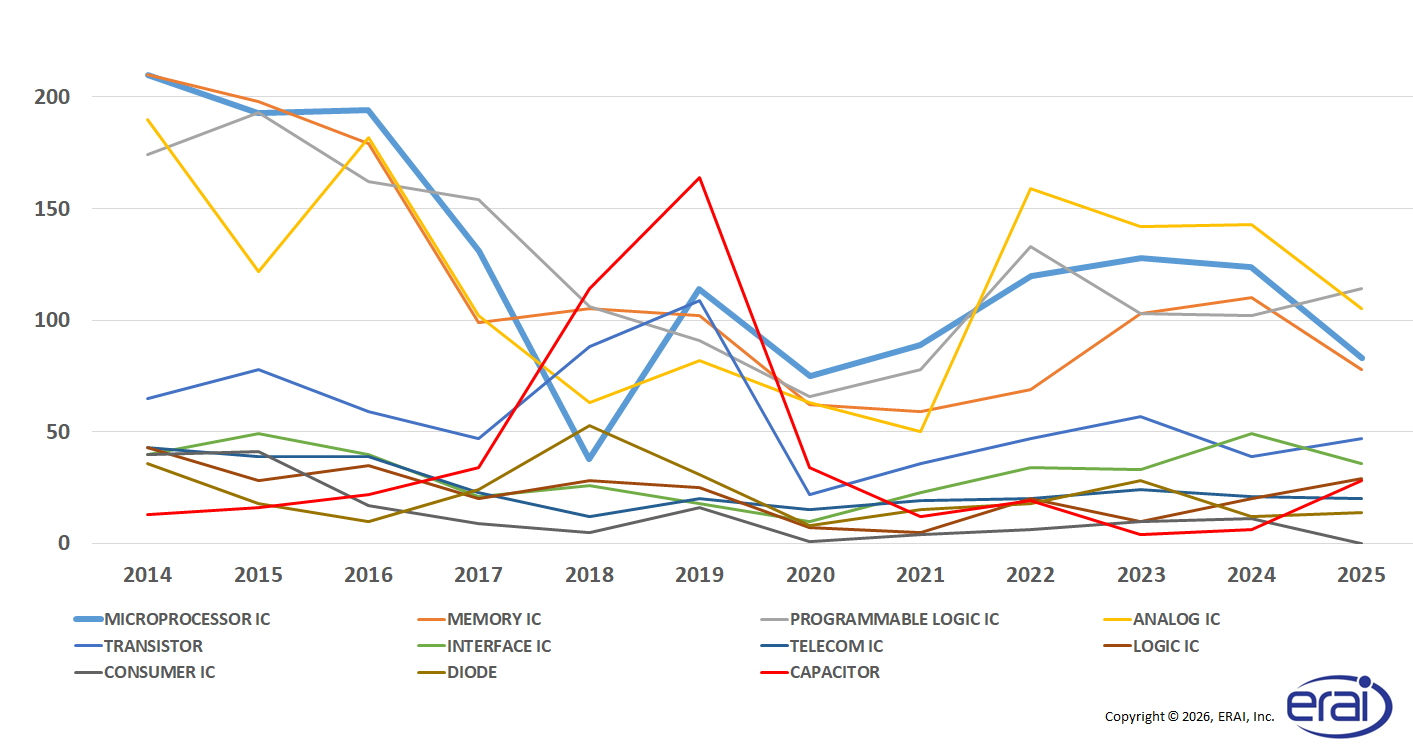
Trend analysis shows that Programmable Logic ICs have emerged as the most frequently reported component type comprising more than 15% of all parts reported to ERAI. Reporting of Microprocessor ICs, Memory ICs, and Analog ICs showed slight decreases compared to 2024. Meanwhile, the decline in reported nonconforming capacitors appears to have ended, with an upward trend observed in 2025 increasing to 3.74%.
Reported Part Type Trends
Types of Nonconformances
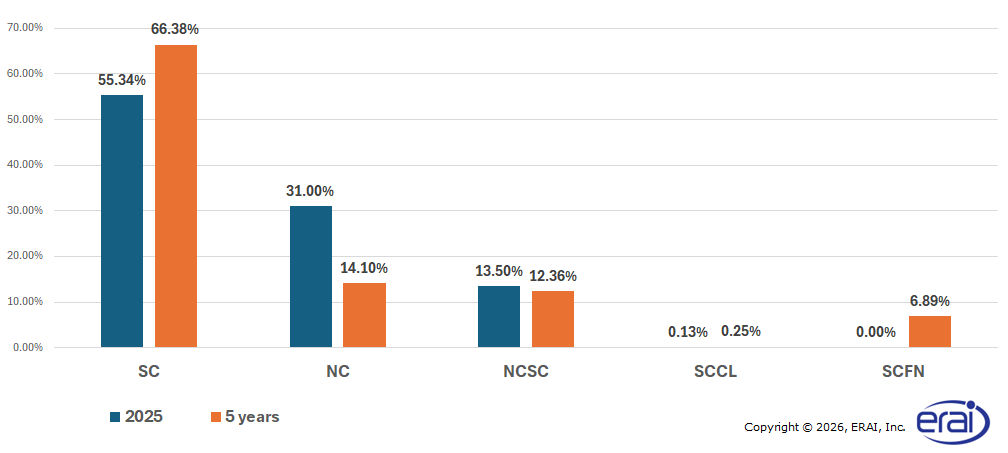
We further analyzed the types of nonconformances assigned to parts reported in 2025 and compared them to the combined data from the previous five years. The distribution closely follows historical trends:
- Suspect Counterfeit (SC): 55.34%
- Nonconforming (NC): 31%
- Nonconforming/Suspect Counterfeit (NCSC): 13.5%
This indicates that a majority of parts (68.84%) reported to ERAI are classified as Suspect Counterfeit.
It should be noted that we observed instances where parts were reported as nonconforming based solely on failed electrical testing, without additional analysis such as visual inspection, X-ray, or decapsulation data made available at the time of reporting. In such cases, parts can only be classified as nonconforming.
Types of Nonconformance in Parts reported 2025 vs. 5 Year period
Testing Sufficiency
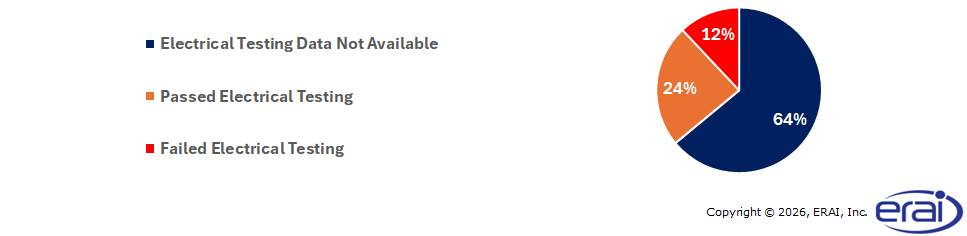
As previously stated, some parts reported to ERAI in 2025 were reported based on results of either electrical testing alone or electrical testing combined with X-ray examination. Most of these parts were reported as NC (nonconforming) because simply failing electrical testing is not enough to suggest that the part is suspect counterfeit in the absence of any other markers. With this in mind, we examined how many suspect counterfeit parts submitted in 2025 (including SC, NCSC, SCCL, and SCFN) underwent electrical testing as well as other tests. The results showed that 24% of Suspect Counterfeit parts passed electrical testing and only 12% failed this test method.
It is likely that the percentage of suspect counterfeit parts passing electrical testing is higher, as reporting entities often omit successful test results and focus only on failures when providing nonconformance reports to ERAI.
This highlights a key point: almost a quarter of suspect counterfeit parts would evade detection if only electrical testing were performed. We can only guess how many of the NC parts that were submitted solely based on electrical failure results would, in fact, be classified as Suspect Counterfeit if additional testing (such as Visual Inspection and Resistance to Solvents) were performed. Comprehensive testing of parts destined for high-risk applications is essential, particularly for components lacking traceability to the original component manufacturer and sourced from the open market.
Suspect Counterfeit Parts Reported in 2025 (SC, NCSC, SCFN and SCCL)
Manufacturer Brands of Parts Reported to ERAI in 2024
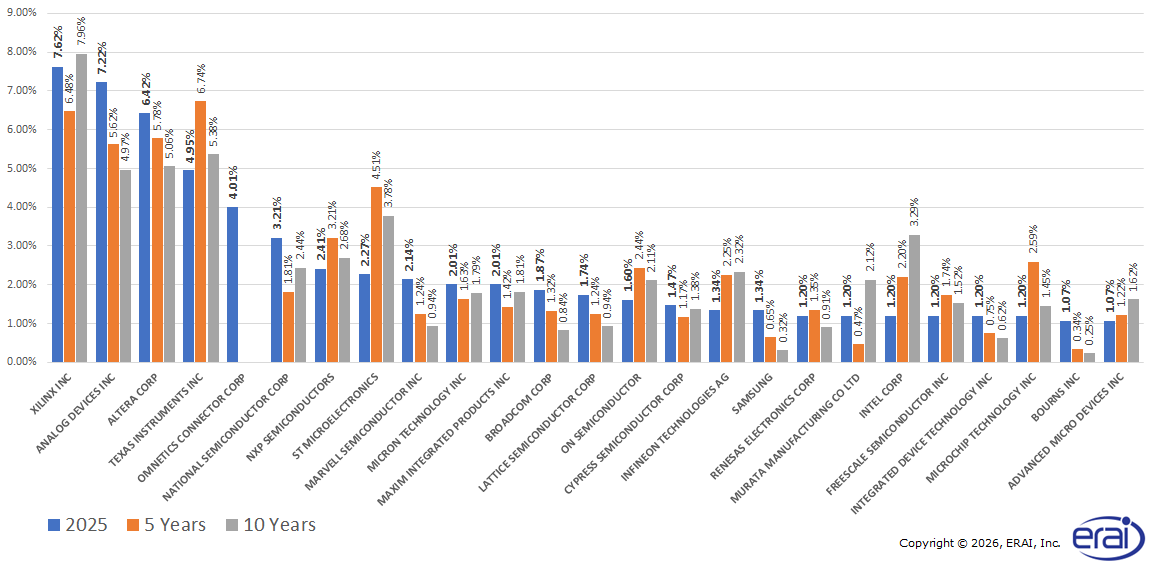
An analysis of manufacturer brands shows that the same major brands continue to dominate the list of most frequently counterfeited parts. Xilinx once again ranked as the most targeted brand, while the overall list remained largely consistent with previous years.
Comparison of Manufacturers of Parts Reported in 2025 vs. Last 5 and 10 Year Periods
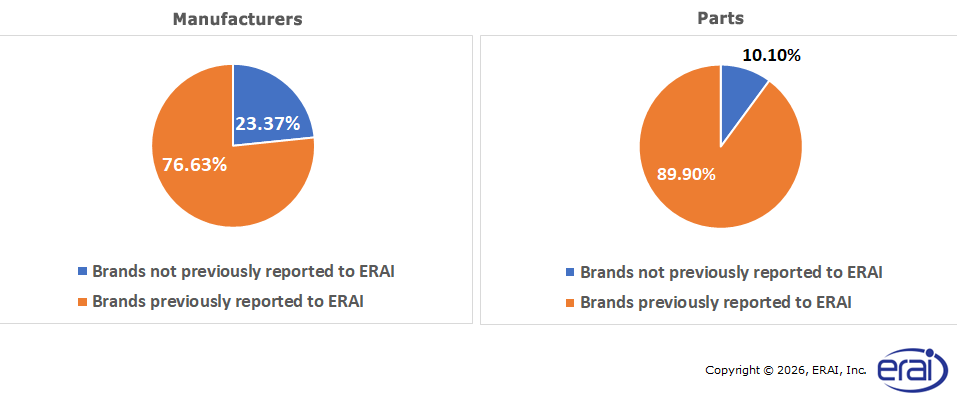
At the same time, there has been a continued increase in the number of newly targeted brands. In 2025:
- 23.37% of reported brands were new (slightly up from 21% in 2024)
- 10.1% of reported parts belonged to brands not previously reported to ERAI
This indicates that counterfeiters’ reach is expanding outside of their commonly targeted group of manufacturers. One example is Omnetics Connector Corporation who became aware of China-based distributors offering their product in quantities larger than were actually manufactured by Omnetics.
New vs. Previously reported Brands in 2025
It is important to note that even niche manufacturers are vulnerable to counterfeiting. In the absence of full traceability, parts sourced outside authorized channels should undergo the same level of scrutiny as high-demand components.
The new manufacturers in 2025 include:
AXICOM
BAREFOOT NETWORKS
CHINASOUND ELECTRONICS CO LTD
CML MICROCIRCUITS INC
CONNFLY ELECTRONIC CO LTD
CURTIS INDUSTRIES
D TECHNOLOGIES
DALICAP
HAWKER
HI-SHEAR CORPORATION
INTEGRATED TELECOM TECHNOLOGY INC
PIONEER MAGNETICS
QDG SEMI
RADIALL S A
RASPBERRY PI
SAINT TECHNOLOGIES INC
SEMICON COMPONENTS INC
SEMICONDUCTOR TECHNOLOGY INC
SEVCON INC
SPECTRUM CONTROL INC
SRC DEVICES
SUN ELECTRONIC INDUSTRIES CORP
|
JOHANSON TECHNOLOGY INC
LINK-PP INT'L TECHNOLOGY CO LIMITED
LOYTEC AMERICAS
MICROSWITCH
NICHIA CORP
NUCLEAR CORP
OMNETICS CONNECTOR CORP
OMNI SPECTRA
PANDUIT CORP
PERKINS AEROSPACE SUPPLY INC
PHOENIX CONTACT INC
SUPER MICRO COMPUTER INC dba SUPERMICRO
SYNQOR INC
TELACE
THE CHERRY CORP
VANGUARD ELECTRONICS
VERNITRON CORP
VLSI TECHNOLOGY INC
WALDOM ELECTRONICS
XP POWER INC
ZYTREX
|
Availability Status of Parts Reported to ERAI
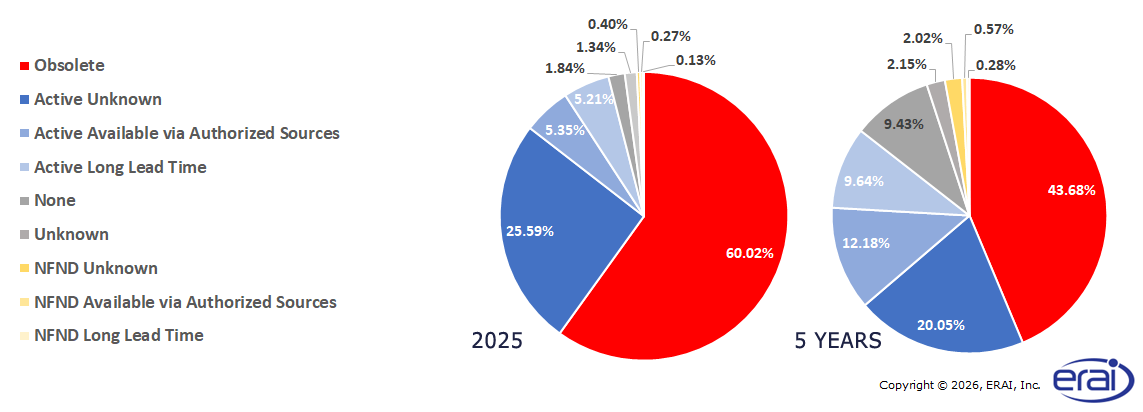
We continued tracking the availability status of components at the time a nonconformance was reported. The objective was to determine if parts were more likely to be counterfeited if designated as obsolete (no longer available via authorized sources), EOL (End of Life) or NFND (Not For New Designs). It is a common misconception that parts that are active and readily available in the market are less likely to be counterfeited as counterfeiters target mostly obsolete parts. Looking at the numbers for 2025, while we saw that obsolete parts continued to be most often counterfeited (60.02%), active components (including readily available, long lead time, and unknown lead time active components) together accounted for 36.15% of reported parts. Comparing this to the last 5 years, we can see that the number of active components reported to ERAI stayed roughly the same. Our data shows that with over one-third of reported parts being active and available for purchase through authorized channels at the time of detection, one can no longer say that if you do not buy or trade obsolete components, you are safe from encountering counterfeit parts.
Availability Status of Reported Parts (2025 vs. Last 5 Years)
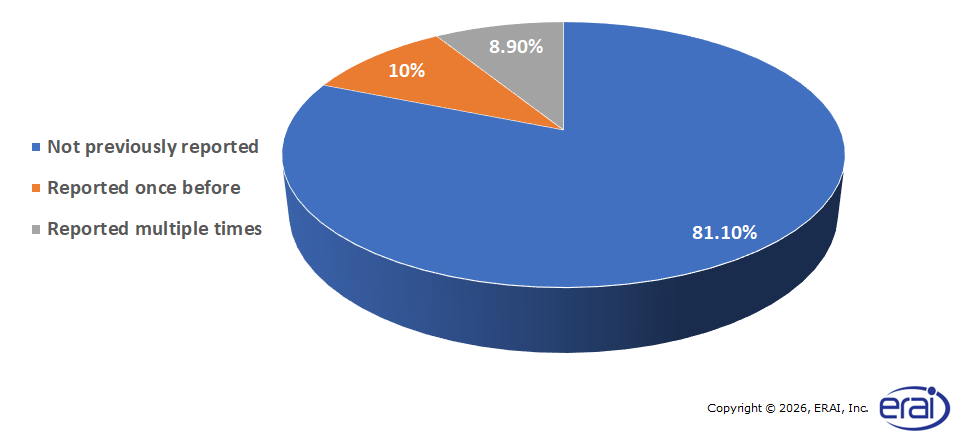
Parts Previously Reported to ERAI vs. Parts Reported for the First Time
An analysis of parts previously reported to ERAI revealed that the majority of parts reported in 2025 show that:
81.1% of parts reported in 2025 were new occurrences
18.9% had been previously reported
8.9% were reported more than once
This trend has remained consistent over recent years. Importantly, a part not appearing in prior reports does not indicate lower risk or merit a lesser level of scrutiny and testing.
New vs. Previously Reported Parts in 2025
Entities Reporting Parts to ERAI
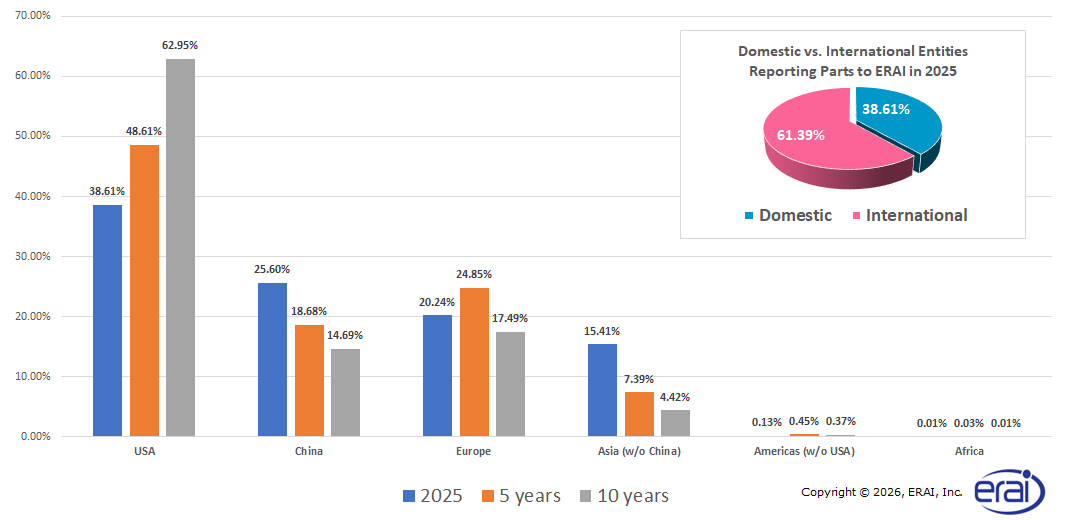
In 2025:
- 38.61% of reports originated from U.S.-based organizations
- 61.39% came from international sources
This highlights the global nature of ERAI’s data and reinforces its value as a comprehensive industry resource.
Geographic Location of Entities Reporting Parts to ERAI in 2025 vs. 5 and 10 Year Periods
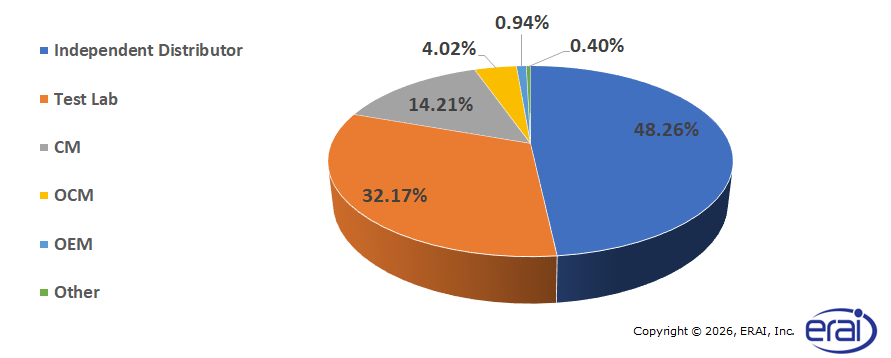
The organizations who reported parts to ERAI in 2025 were comprised of:
- Independent distributors: 48.26%
- Third-party test labs: 32.17%
- Contract Manufacturers: 14.21%
- Original Component Manufacturers: 4.02%
- Original Equipment Manufacturers: 0.94%
Types of Entities Reporting Parts to ERAI in 2025
Summary
Overall, 2025 represents a return to the trend established in 2022 following the post-COVID transition period, with reporting levels similar to those seen in 2022 and 2023.
Key Takeaways
- Growth in global semiconductor sales, largely driven by AI infrastructure, did not result in increased reporting of nonconforming or suspect counterfeit parts.
- Counterfeit parts often pass electrical testing.
- Active parts comprise over a third of parts reported and should not be considered less risky.
- New manufacturer brands are increasingly being targeted.
- Counterfeiting is a global concern as most parts reported to ERAI originate from international sources.
- Reporting is still dominated by independent distributors and test labs, with limited participation from manufacturers.
Closing
As always, we would like to thank the organizations that share data with ERAI. We strongly encourage all companies to report nonconforming parts to ERAI to help ensure that organizations throughout the electronics industry are aware of potential threats. Parts may be reported to ERAI by any organization, regardless of ERAI membership status. Reporting is confidential, as ERAI does not publish information identifying the reporting organization, only the relevant nonconformance data necessary to help others identify similar parts.
To report high-risk or suspect counterfeit parts to ERAI, please email a copy of your internal failure report or third-party test report to reportparts@erai.com. Supplier and customer information may be removed at your discretion. ERAI staff will extract the required data while protecting your anonymity. You may also submit reported parts information through our online reporting interface at ERAI Online Reporting Interface.
If you have any questions or would like to request statistical data not covered in this report, please contact Damir Akhoundov at damir@erai.com. We will do our best to provide the information you need.
SEE MORE BLOG ENTRIES
|